

Subclass 485 visa processing time is a...
Read More-
Amit Taya (Perth): +61 426 488 909 | Harmandeep Kaur (Adelaide): +61 8 8120 4199
Amit Taya (Perth): +61 426 488 909 | Harmandeep Kaur (Adelaide): +61 8 8120 4199
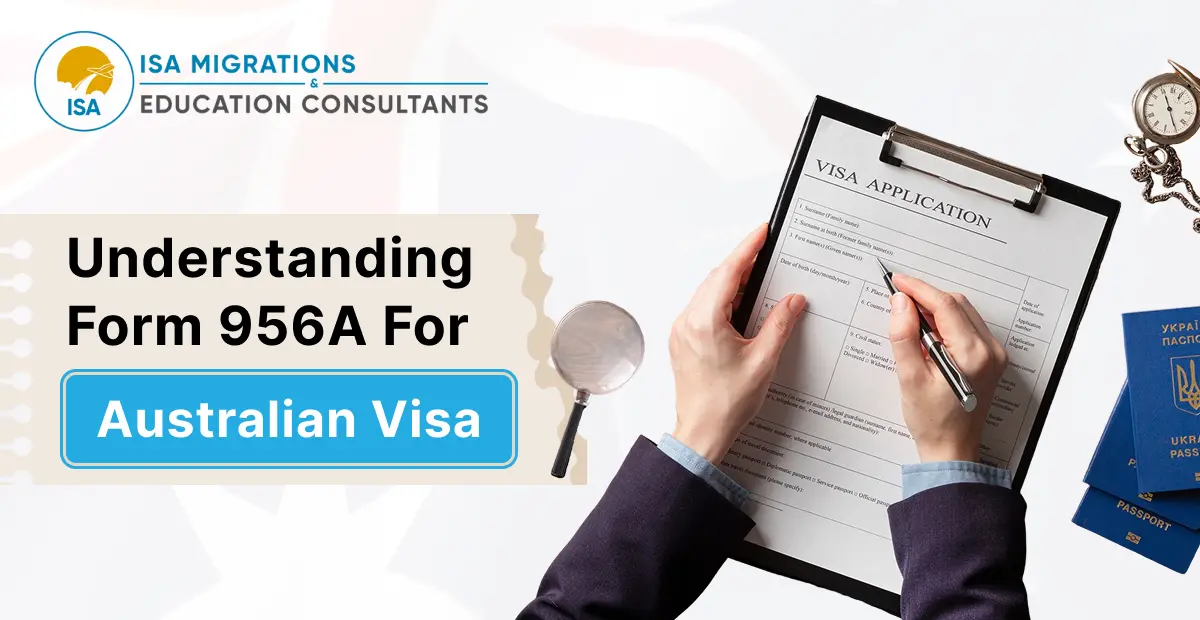
For many visa applicants, Form 956A is only considered important if the handling of their visa issue is not simple. Maybe you are out of the country and cannot stay on top of your communication, or perhaps you would like someone else to receive your correspondence. In this case, an administrative choice will mean much more than you thought it would, especially if your correspondence with the Department of Home Affairs has deadlines or requirements that need to be met. It is just as important to know where your correspondence will go as it is to prepare your visa application.
This guide will help you understand when Form 956A might be required, who can be nominated, and what is different about it compared to Form 956.
Managing Australian visa correspondence might be complicated when you are outside of Australia or depend on someone that you know and trust. The Form 956A in Australia offers you an option to have your authorised recipient receive Department documents on your behalf. It is usually used in several cases regarding immigration.
The form may be relevant when:
Sometimes, this form may overlap with Form 956. So, knowing the differences between Form 956 and 956A lets you get clarity about their purpose. Here are the main differences between both of them:
| Feature | Form 956 | Form 956A |
|---|---|---|
| Main purpose | Appoint someone to provide immigration assistance | Appoint or withdraw an authorised recipient |
| Who Can You Appoint? | Registered Migration Agents, Australian Legal Practitioners, or Exempt Persons | Appointment or withdrawal of an authorised recipient such as your spouse, family member, sponsor, friend or community member |
| Representation | Can cover immigration assistance and representation within the person’s legal authority | Does not itself provide authority to represent the applicant |
| Immigration advice | Yes, where legally permitted | No, unless the person separately has appropriate authority |
You can get the Form 956A from the official sources of the Department of Home Affairs or a migration agent. Here is a simplified way to get the form:
Read the 956A form examples to get a clear idea about how it is filled out. If you have any queries, consult a migration agent right away.
Also Read: Australian Citizenship Processing Time 2026
There are three parts in the official Form 956A. Complete Part A and Part C for a new appointment, or Part B and Part C when withdrawing an appointment. Here are step-by-step Form 956A instructions to complete each part:
Provide your details, which include your full name, date of birth and Home Affairs Client ID. Next, choose your applicant category and provide details of the application, cancellation or other matter involved. These immigration forms for Australia also require filling out the name, date of birth, address and contact details of the authorised recipient.
Fill in this section in case of cancellation of an already appointed authorised recipient. Otherwise, you can skip this. Provide your details, details of the authorised recipient and any details that can identify the application, cancellation or other matter. Include the HA Request ID or Transaction Reference Number if known.
Choose the appropriate Form 956A appointment or cancellation declaration. The authorised recipient and applicant should make the necessary declarations and sign and date accordingly. Other applicants who are 16 years or older should also sign where necessary.
To complete this form, hiring regional experts like an immigration agent in Perth is also a suitable option. They can help you ensure that all details are correct.
The most common mistakes are related to clicking on the 956A form download link and filling out the main sections incorrectly. Make sure that you have not made any of these mistakes before submitting your application:
Also Read: How to Track Your Australia Visa Application Status Easily?
Once you submit the 956A form, the Department of Home Affairs updates its records to reflect the authorised recipient. The Department then sends you a written confirmation and may continue sending relevant correspondence about the application’s progress. Meanwhile, you should monitor the contact details and respond to any queries asked by the immigration authorities.
After completing and signing Form 956A, you may file it using the appropriate channel for your visa application. Here are some common ways to submit this form:
ImmiAccount: ImmiAccount gives you a Form 956A fill online option, letting you complete and submit the form digitally in a few simple steps.
Email: The form can be emailed to the Department of Home Affairs. But the maximum size of the file is 10MB.
Offline System: In case of offline submission, the form can be sent to the address provided by the Department of Home Affairs on its website. It needs to be ensured that the form is sent to the right office.
The Form 956A for Australia visas is a useful tool if you are considering someone to manage your visa correspondence. It allows your spouse, family member, sponsor, friend or community member to receive immigration documents on your behalf. But before submitting, confirm whether Form 956A or Form 956 applies to your situation.
Need help with which form or appointment is right for your visa matter? Get assistance from qualified immigration consultants today!
Yes, you can appoint one later if needed for the 956A form in Australia. Follow the Department of Home Affairs instructions for your specific visa matter.
Yes, a dependent child aged 16 or over may nominate a different authorised recipient for their own immigration situations.
Yes, but immigration professionals generally use Form 956 when providing immigration assistance. Form 956A is not a substitute for that appointment.
An appointment generally remains valid until it is formally cancelled using Part B of the form, the matter it relates to is finalised, or the Department is otherwise notified of a change.
The form relates to authorised recipients instead of a specific visa subclass. Its relevance depends on the immigration matter and communication requirements.